
The product
The standard factory processes are already inside.
EMMa connects customer orders, planning, production, quality, maintenance, warehouse, people and improvement. When something important happens, EMMa starts the right process, gives work to the right people and records the result. The standard processes, roles and measurements are already included, so the factory checks and adapts them instead of designing everything from an empty system.
/ 01 — What is different
The processes are already included
The factory does not start from an empty system. The standard processes are built in, and they start by themselves when something happens — and the work goes to a real named person. Nobody has to remember a procedure the system could have started for them.
Work is connected
Information from one area can start work in another area. A quality problem can raise maintenance work. A late delivery can change the plan. Each page answers one clear question a person would actually ask: is the plant on target?, what is on me today?, can we meet this order?
Results are measured
Completed work feeds the KPIs and the improvement actions. Because the work happens inside the process, the record of who did what and when is created automatically. Preparing for an audit stops being a search through old files.
/ 02 — One product, many factory shapes
EMMa is strict about how work is controlled, not about what your plant looks like.
The shape of the factory is yours to set up. There is no assumed number of production areas, shifts or products, and no assumed industry. Any example named on this site describes one configured plant — it is not a limit on what EMMa supports.
Your factory configures
- As many production areas as you run
- Any working programs and shift patterns
- Machines, lines, work centres and tooling
- Products and production configurations
- The plant calendar
- Departments, job titles and people
- Reference catalogues and document types
- KPI targets, owners and review dates
- Cost models and capacity profiles
- Quality plans and control characteristics
- Customer agreements and supplier terms
- Notification text and delay values
What is fixed
The built-in business processes
The steps, their order, what starts each one, and the record each step must leave.
The standard roles
The named responsibilities every process step points at.
During implementation you connect those standard roles to your own departments, job titles and employees.
/ 03 — Operational domains
The factory, end to end.
Grouped by the job each area does, in the words people use for that work.
Commercial
Keeps customer agreements, prices and forecasts. Takes in orders and changes, checks capacity and materials before a delivery date is promised, and records who approved the commitment.
Sales & operations planning
Plans demand and capacity period by period, compares what customers want with what the plant can make, and records the agreed plan.
Production planning
Checks materials and capacity, plans production by shift, reserves machines and people, groups similar production to reduce setups, and keeps the history of every plan change.
Production execution
Releases orders after checking materials, runs the shift by area, and records produced quantity, scrap, downtime, material used, quality results, machine settings and who worked.
Quality
Records the quality plan and the checks. When a problem is found it records it, assigns the immediate actions, tracks the root cause and corrective actions, and keeps the full history until the case is closed.
Maintenance & assets
Shows what equipment is stopped, what maintenance is due, who is working on it and what happened before. Covers preventive plans, repairs, failure causes and spare parts.
Inventory & warehouse
Receives goods, tracks stock and movements, reserves material for production, handles stock counts and corrections, and receives finished goods from production.
Kanban & line feeding
Keeps material at the line: kanban rules, calls for replenishment, what was used, and what is left at the point of use.
Procurement
Keeps supplier terms and prices, raises purchase orders, follows deliveries and differences, and sends larger commitments for finance review.
Engineering & technical data
Keeps approved product information, bills of material, equipment setup and technical data sheets under version control.
Product industrialization
Runs new product projects: milestones, decisions at each gate, targets, risks, budget, the team, and engineering changes with what each change affects.
Production parameters
Keeps the approved machine settings, who may change them, and the checks recorded against the rules that were valid at the time.
People & competence
Employees, departments and job titles. Hiring, onboarding, evaluations, leave, and the skills and training each job requires.
Documents
Controlled documents with versions, who must read them, confirmation that they were read, and short comprehension checks.
Work & collaboration
Tasks with history and comments, meetings, effort, escalation, and the link from a KPI to the task raised because of it.
Performance & KPIs
KPI values, owners and department scorecards. Calculations are run, and can be corrected and recalculated when late data arrives.
Operational analysis & cost
Compares planned and actual cost, shows where the difference came from, and covers energy use and manpower cost.
Business process model
The written process register: inputs, outputs, controls, resources, roles, risks, required skills, linked KPIs and documents, and process audits.
Master data & configuration
The plant model and its reference data: calendar, shift systems, capacity, cost models, quality plans and supplier terms.
Platform services
Notifications, languages and translations, tagging, support tickets, and user accounts and roles.
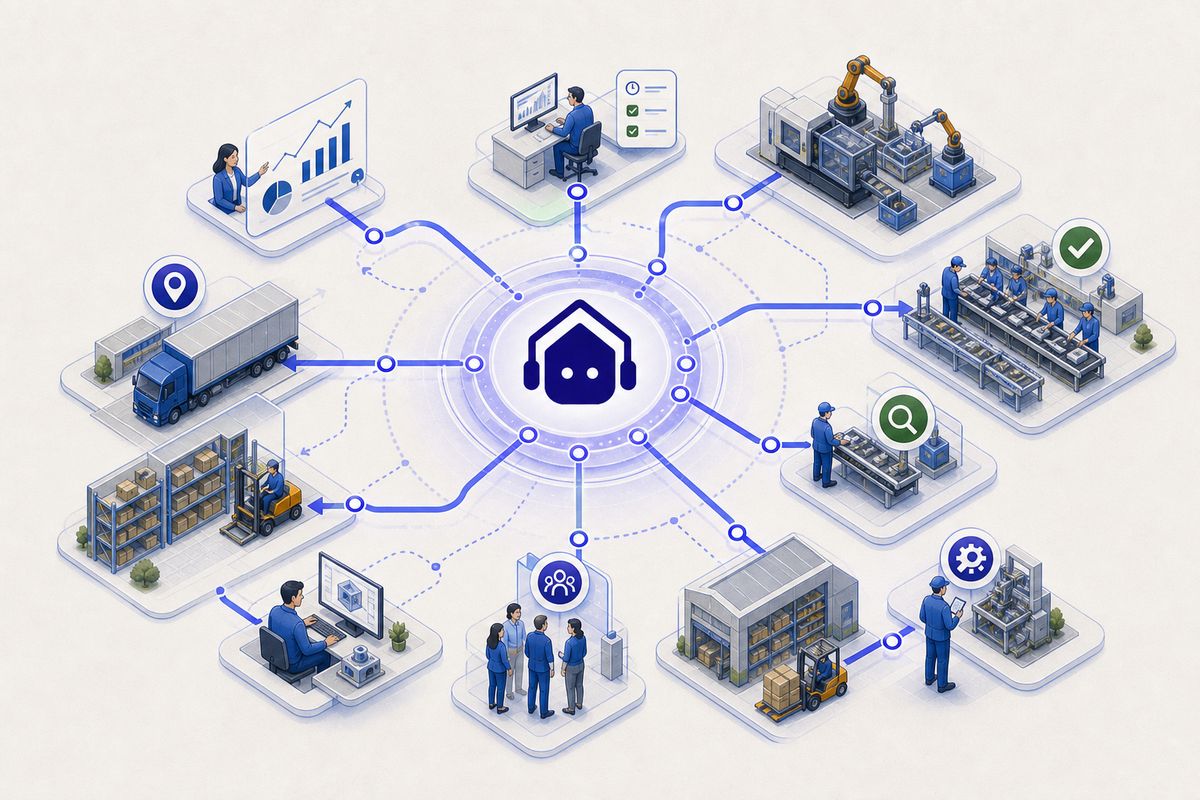
The difference is not the module list. It is that the modules are connected.
One area records a fact. That fact starts a process. The process gives the work to a named person. The finished work leaves a record. Most factories already have the separate areas; few have the connection between them.
/ 04 — Process routes
Five routes that cross every department.
Each of these crosses departments that, in most factories, pass work to each other by email and hope.
A · Customer demand to delivery
- Customer order
- Demand review
- Capacity validation
- Material validation
- Delivery commitment
- Production planning
- Production execution
- Warehouse
- Delivery confirmed
B · New product to serial production
- Requirement
- Industrialization
- Process definition
- Tool readiness
- Trial production
- Capability validation
- Training
- Production release
- Serial production
C · Employee lifecycle
- Employee created
- Onboarding
- Training plan
- Training
- Qualification
- Assignment to work
- Development
- Offboarding
D · Problem to improvement
- Problem detected
- Containment
- Root cause
- Corrective action
- Verification
- Standardization
- Lesson learned
E · Equipment lifecycle
- Equipment registered
- Maintenance plan
- Preventive maintenance
- Breakdown
- Repair
- Verification
- History & improvement
/ 05 — The engine behind EMMa
EMMa is built on a framework, not assembled page by page.
An application this size is only consistent if the way it is built is consistent. EMMa Operations is built on CodingWithEase, a .NET framework I develop for business and operational applications.
The same structure everywhere
Navigation, lists, forms, permissions and pages follow one set of conventions. A screen in maintenance behaves like a screen in quality, so people learn the application once.
Mistakes are made hard to build
Rules live in generated code, strong types and automatic checks rather than in a document telling a developer to remember them. Problems surface while the code is written, not in production.
Permissions belong to the architecture
Hiding a button is user experience. The real check stays on the server, next to the operation it protects, and follows the responsibility a person actually has.
This is the same thinking that runs a factory, applied to software: standardise what repeats, prevent the mistake instead of warning about it, detect problems early, and improve the system rather than every application separately. It is also what lets AI coding agents work on EMMa productively — they operate inside a defined structure instead of inventing a new one each time.
/ 06 — For IT and software teams
How it works underneath.
This section is for software and IT readers. Everything a factory needs to judge EMMa is in the sections above — this one explains how the processes, events and records are handled inside the product.
Definitions
- Application-defined processes. Steps, transitions and event bindings ship with the product. A factory user cannot restructure a process, and does not have to invent one.
- Immutable released versions. Once released, a version never changes. A new version supersedes it.
- Publication control. Trigger and persona indexes are built at publication, not looked up ad hoc.
- Configuration history. Every permitted factory override is recorded with who changed it and when.
Events and runtime
- Durable event outbox. Events are persisted before dispatch, so a process is not lost to a restart.
- Idempotent processing. The same fact never starts the same process twice.
- Dead-letter queue. An event that cannot be handled is visible and re-drivable, not silently dropped.
- Event waits and process tokens. A step can wait for a supplier response or a qualification result; parallel branches and joins are tracked explicitly.
Work and proof
- Assignments are durable records. Text, due date, assignee and the versions in force are frozen at creation. A later change does not rewrite what somebody was asked to do.
- A sweep that runs regardless of who is looking. Overdue and escalation raises are computed on a timer by a background service. A condition computed only in a screen never actually fires.
- As-of reconstruction. Effective-dated configuration answers what was in force then?, not only what is in force now?
- Recalculation, not silent rewriting. When late evidence arrives a checkpoint is recalculated and superseded explicitly.
/ 07 — Performance
KPIs are defined in the system, not built differently by every user.
Each KPI has one formula and one meaning: the inputs, how it may be grouped, and what happens when data arrives late or is corrected. The same OEE calculation is used whether you look at one machine, one shift or one area. Thirteen topics cover the plant.
01
Demand & customer orders
Forecast accuracy and bias, demand coverage, revision and cancellation rate, intake lead time, feasibility success.
02
Fulfillment & outbound
OTIF, on-time delivery, fill rate, fulfillment lead time, on-time staging and dispatch.
03
Master data & engineering
Definition completeness, release timeliness, change throughput.
04
Planning & capacity
Plan stability, capacity utilization, schedule adherence, reservation conflicts.
05
Execution & OEE
OEE from authoritative inputs, availability, performance, quality rate, downtime and scrap analysis.
06
Quality & parameter conformance
Nonconformance rates, containment and disposition timeliness, parameter conformance, inspection performance.
07
Material & inventory
Inventory accuracy, coverage, shortage impact, reconciliation variance.
08
Production material kanban
Call response time, line-feeding punctuality, point-of-use stockouts.
09
Procurement & suppliers
Supplier on-time delivery, quantity variance, terms compliance, response time.
10
Maintenance & reliability
MTBF, MTTR, plan compliance, breakdown impact.
11
Spare parts
Stock coverage, alert response, consumption against plan.
12
Cost, equipment & energy
Cost variance, manpower cost allocation, energy performance, equipment baselines.
13
Integration & data quality
Interface health, stale evidence, declaration completeness.
Three kinds, never mixed
A KPI is a measured result you can compare over time. A supporting measure is a quantity used inside a KPI. An operational indicator shows a risk or a queue right now, to decide something today.
Definition independent of grouping
OEE by machine and day, and OEE by area and week, are the same definition looked at differently — not two KPIs giving two answers.
A red KPI becomes work
Each indicator has an owner, targets, a review date and a link to the tasks raised because of it — so a KPI below target becomes an action with an owner and a due date, not a discussion.
/ 08 — Implementation
Start from a standard factory model, then adapt it to your plant.
Because the standard processes come with the product, the usual first phase — months of workshops to design processes — becomes a review of processes that already exist and already run.
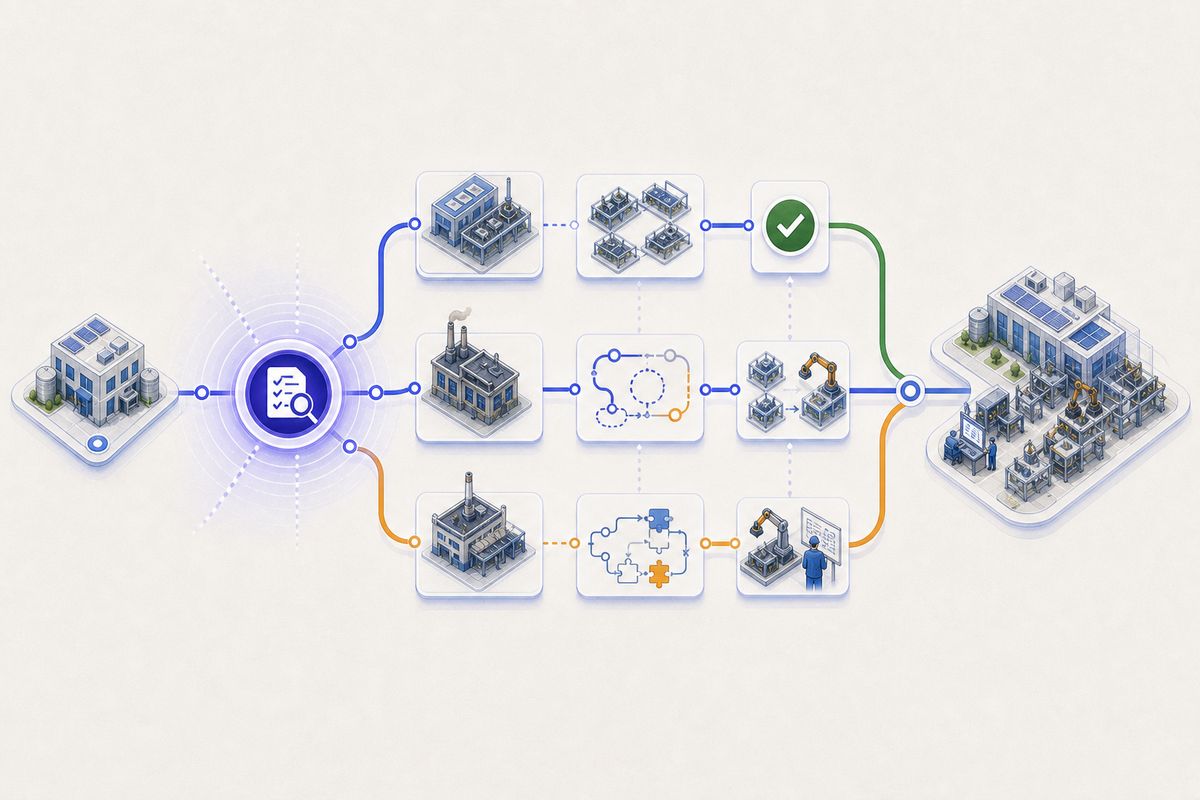
Outcome 01Standard fitThe built-in process matches how the plant should work. Adopt it as it is, connect it to your departments and job titles, and train the people in each role.
Outcome 02Process improvementThe built-in process is better than current practice. The difference is a legacy habit, not a requirement. Change the practice.
Outcome 03Valid business gapA genuine requirement the standard does not cover — a customer approval gate, a regulatory validation, a cleanroom release. Extend the standard deliberately.
Standard where standardization creates value; specific where the business genuinely requires it.
Download & share
Take the product overview with you.
The full EMMa Operations presentation, in one PDF. Share it with your plant management team, your IT department, or anyone deciding what a factory system should do.
PDF · 27 pages · 709 KB · free to share
One place that answers what is on me.
Every employee, from operator to plant manager, gets My Work: the tasks from every process ordered by urgency, the shift they are on, the documents they must read, and their own account. Nobody needs to know which part of the system a task came from.