
The method
A process should not only say what people should do.It should help make sure the work actually happens.
EMM connects business events, processes, responsibilities, actions and results. When something important happens, the right process starts and the right people know what they need to do. It works in any company, with any software.
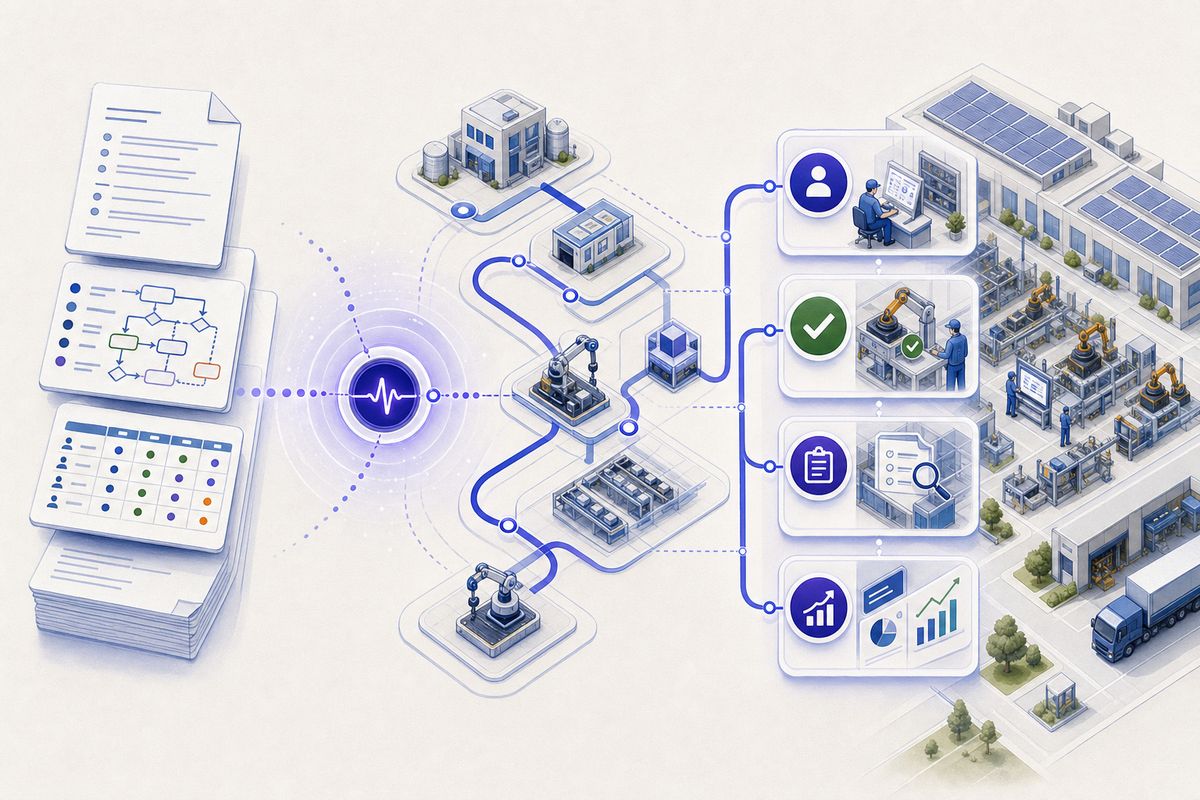
A written procedure describes the work. A connected system takes part in it.
Procedures, responsibility charts and work instructions are usually correct, but they sit still and wait. EMM connects them to the events that should start them, the people who should act, and the record of what was done.
/ 01 — The four weaknesses
What a written-down system cannot do.
A management system can be complete on paper and still fail in four ways. Each one is a broken connection, and each has the same shape: something happened, and the system did not know.
Weakness 01
Start TRIGGER
The company has written down what should happen, but nothing connects the process to the event that should start it. It depends on someone remembering, and on an email or a conversation.
A person is hired
↓ someone must remember
↓ someone emails IT
Weakness 02
Responsibility
A responsibility chart says the trainer is responsible. That sentence does not create work for the person who actually does that job today.
Standard role
↓ job title
↓ a named employee
↓ an assignment
Weakness 03
Steps EXECUTION
A machine stops and repair work should start. A document cannot check that the steps were done in order, that the approvals were given, that everyone finished their part, that the dates held, or that the job ended properly.
EMM maintains process state.
The system knows where a
real instance currently is.
Weakness 04
Record EVIDENCE
A document explains how the factory should work. It cannot tell you how the factory actually worked — who did it, when, under which version of the rules, and with what result.
Designed process
↕
Executed process
/ 02 — The four stages
Define, connect, run, record.
Four questions, asked in order. Most management systems answer the first one well, the second one informally, and the last two only when an auditor asks.
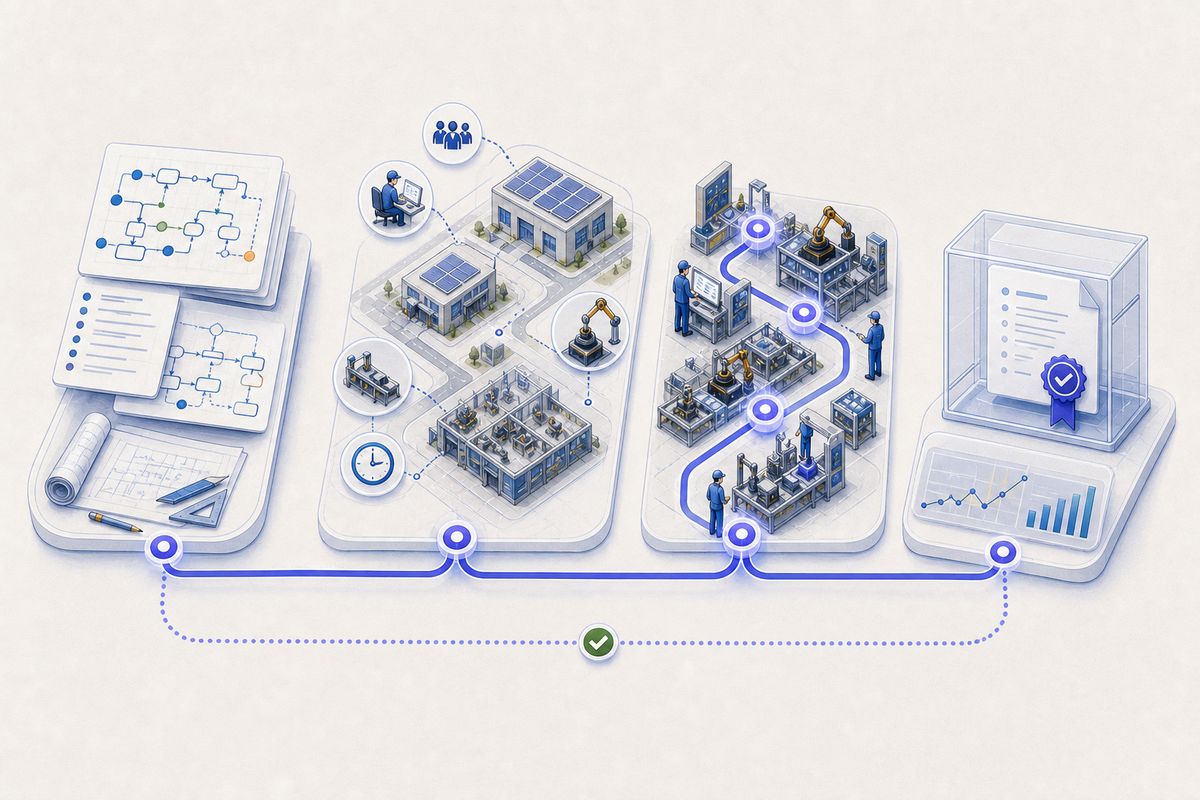
Define · designHow should the process work?The areas, processes, steps, owners, standard roles, responsibilities, risks, controls, KPIs and the records each step must leave.
Connect · configureWhich real people and roles are responsible?Standard roles are connected to real job titles and real employees, so the process still works when someone leaves.
Run · executeWhat is happening now?An event in the software starts the process, finds who is responsible, gives them the work, and waits for the result.
Record · proveWhat actually happened?Who did it, when, under which version of the rules, with which records, and whether the process finished correctly.
/ 03 — The operating loop
A closed loop between the designed system and reality.
- Business event
- Business process
- Responsibility
- Assignment
- Action
- Validation
- Evidence
- Performance
- Improvement
Business events carry business facts
An order accepted, an employee hired, a machine stopped, a nonconformance raised. Not ButtonClicked or PageOpened — meaningful changes in business reality.
A module publishes the fact. It does not need to know which processes depend on it. The business system decides what that fact starts — and one fact can legitimately start several processes that then run independently.
Responsibility becomes real work
Responsible produces an assignment. Accountable produces an approval or an escalation. Consulted and Informed produce notifications. Responsibility stops being a label in a document.
Assignment
You must do something. It has a due date, an expected result and a completion.
Notification
You need to know something. It does not require completion.
/ 04 — Definition and instance
Changing the rules tomorrow must not rewrite yesterday.
Process definition
The approved standard process
Like an approved work instruction: the steps, their order, and the records each step must leave. It is released as a version. Once released it does not change — a new version replaces it.
Process instance
One real case following that process
One employee being onboarded, one customer order, one machine repair. Each case remembers which version of the process and which setup it started under, permanently.
Why it matters
Old records keep their meaning
If the process changes next month, old records still keep the rules that were valid when the work was done. A record from two years ago still means what it meant then.
/ 05 — For IT and software teams
What EMM is not.
This section is written for software and IT readers. If you are looking at EMM as a way to manage the factory, the sections above cover what it does.
Not a workflow engine
A workflow engine answers which step runs next. EMM covers more than that: areas, owners, standard roles, risks, controls, skills, documents, records, performance and improvement. Running the steps is only one part of it.
Not a replacement for normal architecture
Software should still be built from business requirements in the usual way. EMM adds one thing: the operating model stays visible and connected to the software after it is built, instead of disappearing into the code.
EMM does not compete with Lean, Six Sigma or ISO management systems. It is the layer that keeps them connected to what the software actually did.
Download & share
Take the method with you.
The full Efficiency Management Method presentation, in one PDF. Share it with colleagues, use it in a meeting, send it to anyone who should understand how a written process becomes real work.
PDF · 26 pages · 626 KB · free to share
EMM is the method. EMMa is the factory application built with it.
The method works in any industry. EMMa Operations is the manufacturing application built with it, and it arrives with the standard factory processes already defined instead of as an empty platform.
What is EMMa