
Public release · 15 September 2026
The operating system for your factory.
Connect people, processes and daily operations.
EMMa connects the main work of the factory in one system. It helps people know what they need to do, shows what is happening now, and turns problems into actions and measurable results.

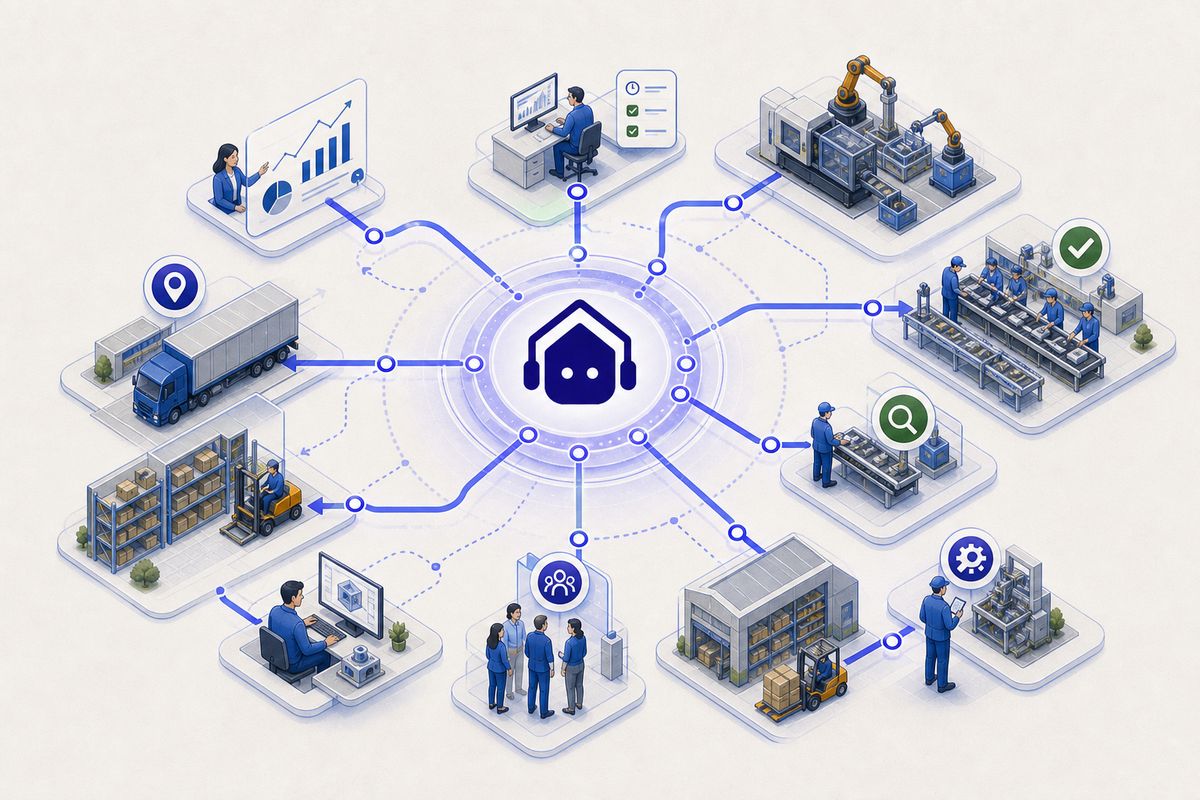
Planning, production, quality, maintenance and delivery work in one connected system.
When something important happens, EMMa starts the right process, gives the work to the right person, and records the result.
/ 01 — The problem
The rules and the daily work are kept apart.
Most factories have two separate things. One is the written system: procedures, process maps, responsibility charts, work instructions. The other is the software people use every day. The written procedure says who is responsible. The software does not know.
Weakness 01
Start
The process is written down, but it only starts if somebody remembers. A new employee is hired, and someone has to remember to tell IT, training and the shift leader.
Weakness 02
Responsibility
A responsibility chart says the trainer is responsible. It does not put the work in front of the person doing that job today.
Weakness 03
Steps
A machine stops and maintenance work should start. A written procedure cannot check that the steps were done in order, that the approvals were given, or that the job was finished properly.
Weakness 04
Record
A KPI is below target and an improvement action is needed. A document explains how the factory should work. It cannot tell you what actually happened, who did it, or when.
A process should not only say what people should do. It should start the work, guide it, and record what happened.
The core principle of EMM
/ 02 — Two names
EMM is the method. EMMa is the product built to it.
The method
EMM
Efficiency Management Method
A method for connecting the processes a company defines with the work people actually do. It describes how an event, the process it starts, the person responsible, the steps and the final record stay connected — in any company, with any software.
- Works in any industry
- Defines how a written process starts real work
- Complements Lean, Six Sigma and ISO management systems
- It is a method, not a piece of software
The product
EMMa
Standard manufacturing operating system
The factory application built using that method. The standard factory processes, roles and measurements are already included. The factory checks and adapts them instead of designing everything from an empty system.
- Built for manufacturing, not for everything
- Arrives with the standard processes already inside
- Covers the plant from customer order to delivery
- You start from a working standard, not an empty system
/ 03 — Who builds it, and on what
Eleven years of factory systems, not a few months of software.
I have worked as a Factory Operations Manager and as a software developer. EMMa comes from both: I started building operational systems for factories in 2015, and EMMa is the one that carries those years forward with current technology and AI.
Two sides of the same question
Most factory software is built by people who know software, or specified by people who know factories. Working on both sides means one person asks both sets of questions about the same screen — does it match the real process, and can the code be maintained — and has to answer them together.
The engine underneath
EMMa is built on CodingWithEase, a .NET framework I develop for business and operational applications. It applies factory thinking to software: standardise what repeats, prevent the mistake instead of warning about it, and improve the framework rather than every application separately.
/ 04 — Who it’s for
EMMa shows each person what matters to their role.
The home screen shows only the areas a person works in, and puts the biggest problem first. An operator sees a short list. A plant manager sees more. Both see what needs attention before anything else.
/ 05 — The unit of work
Production is planned and measured by shift.
Work is planned by shift, not by month: where, when and on which machine. The same shift also carries OEE, scrap, downtime, who was working, the handover and the maintenance. This makes planning easier, makes OEE easier to review, and makes it clear who is responsible for each shift.

Example: one configured plant
Shift 106:00 – 14:00
Shift 214:00 – 22:00
Shift 322:00 – 06:00
PatternMon – Fri
The three shifts above are one example, not a requirement. EMMa has no fixed number of production areas, shifts or products, and no assumed industry — you set up the shape of your own plant. What you configure, and what is fixed →
/ 06 — Release
EMMa Operations launches 15 September 2026.
On the day
The product becomes available
Factories can start reviewing EMMa, its standard processes and what is needed to install it.
On the day
Walkthrough videos are published
Recorded from the real application: the home page, one complete process from start to final record, a shift on the floor, and a KPI below target becoming an action with an owner.
Before or after
Talks can start now
A factory does not design every process from zero. We compare the standard EMMa processes with your factory and agree what stays standard and what needs to change. That conversation is welcome before the launch date as much as after it.
/ 07 — Read it, and pass it on
Two presentations, free to download and share.
One explains the method, one explains the product. Send them to a colleague, open them in a meeting, or forward them to anyone who should see how a factory can work when its processes and its software are connected.
The method
Efficiency Management Method
How a written process starts real work, gives it to the right person, and records what happened.
26 pages · 626 KB
The product
EMMa Operations
The factory operating system built with that method, and what it covers from customer order to delivery.
27 pages · 709 KB

Welcome to the House of EMMa.
If you manage a factory and want to connect people, processes and daily work in one system, let’s talk.